You finally sit down.
There was something you wanted to write about a minute ago. Probably several things.
But now your notebook is open, your pen is ready, and all you can think is:
“What am I supposed to write?”
If you’re wondering how to journal for beginners, start here: write one honest sentence about what’s on your mind. You can use a notebook, a piece of paper, or a notes app.
You don’t need to describe your whole day.
Maybe you’re still thinking about a conversation. Maybe tomorrow’s school reminder keeps coming back. Maybe you’re disappointed that the evening disappeared into dishes and laundry again.
Any of those thoughts can be your first sentence.
Here’s a simple evening practice you can try, even when you only have a few minutes.
1. Choose somewhere easy to write
Use something you already have.
A half-used notebook counts. So does a loose sheet of paper or a digital journal you’re comfortable using.
Choose the option you’re most likely to reach for when the house finally gets quiet.
If you prefer handwriting, keep your pen with your notebook. If you prefer typing, keep your journal somewhere easy to find on your device.
You can make it beautiful later, if you want to.
For now, make it easy to begin.
2. Answer one small question
A blank page leaves a lot of room for wondering where to start.
Give yourself a smaller starting point:
What am I still carrying from today?
Your answer might be:
“I keep remembering the school form I need to return.”
“I wish I’d handled that conversation differently.”
“Today felt full, and I haven’t had a moment to notice how I’m doing.”
Choose the thought that comes to mind first.
You don’t have to explain it perfectly. You’re simply giving it somewhere to go.
3. Write the ordinary version
Your journal can sound like you.
Short sentences. Unfinished thoughts. A small list.
For example:
“Long day. Need to reply to that message. Still haven’t found the library book. Dinner was rushed, but we laughed together.”
That is a journal entry.
It holds a few reminders and a moment you might otherwise forget. It doesn’t need a lesson or a thoughtful ending to count.
If another sentence comes, write it.
If you’re finished, you can leave it there.
4. Decide what needs action—and what can wait
This is where evening journaling can accidentally become another list of things to do before bed.
You write “school form” and reach for your bag.
You write “laundry” and think about starting another load.
Before getting up, pause.
Writing something down doesn’t mean you have to act on it tonight.
Look at what you wrote and ask:
Does this need my attention now, or can I return to it tomorrow?
For a reminder, give yourself a clear next step:
“Check the school form after breakfast.”
For something you can’t resolve tonight, you might write:
“I’m leaving this here for now.”
If there is a deadline you need to remember, put it in the calendar or reminder system you actually use. Your journal doesn’t have to hold that responsibility by itself.
The point is to choose what happens next, rather than letting every thought become another evening task.
5. Give your entry an ending
You don’t have to write until you run out of thoughts.
Choose one sentence to finish with:
- Tomorrow, the one thing I want to focus on is…
- Something that went right today was…
- For tonight, I’m letting this wait…
Then close the notebook or save your entry.
Some evenings, you may want to write more. Other evenings, one sentence and a reminder will be enough.
You get to decide where the writing ends.
A simple evening journal example
Here’s what a short entry could look like:
What I’m carrying:
The kitchen is still untidy, and I’m worried I’ll forget tomorrow’s library book.
What can wait:
Sorting the kitchen drawer. It doesn’t need to happen tonight.
Tomorrow’s one thing:
Put the library book in the school bag before we leave.
Something that went right:
We sat together for dinner, even though it was quick.
My closing sentence:
I’ve written down what I need to remember. I can leave the rest for tomorrow.
Your entry doesn’t need all five parts. Start with whichever question feels useful.
And if your thoughts are mostly about everything the coming week needs, this simple Sunday reset routine offers practical ways to check the calendar, prepare for Monday, and choose what can wait.
Questions you might have when you start journaling
Do I need to journal every day?
Choose a rhythm that fits your life.
If you miss a few evenings, begin with today when you return. You don’t owe your journal a summary of everything that happened while it was closed.
What if I don’t know what to write?
Describe one moment from your day.
Something that bothered you. Something you want to remember. Something small that made you smile.
You can begin with: “The thing I keep thinking about is…”
How long should I write?
Try one to five minutes to begin.
You can continue when you want to. You can also stop after one useful sentence.
The length of the entry doesn’t need to become another thing to keep up with.
Want a guided place to begin tonight?
The free 5-Minute Evening Journal Reset puts the questions in one place, so you don’t have to think of a prompt when you’re already tired.
It guides you through:
- What you’re carrying.
- What can wait.
- What went right.
- Tomorrow’s one thing.
- A simple way to close the day.
It’s printable and fillable. Write by hand, or type into the PDF using a compatible PDF reader.
Get the Free 5-Minute Evening Journal Reset →
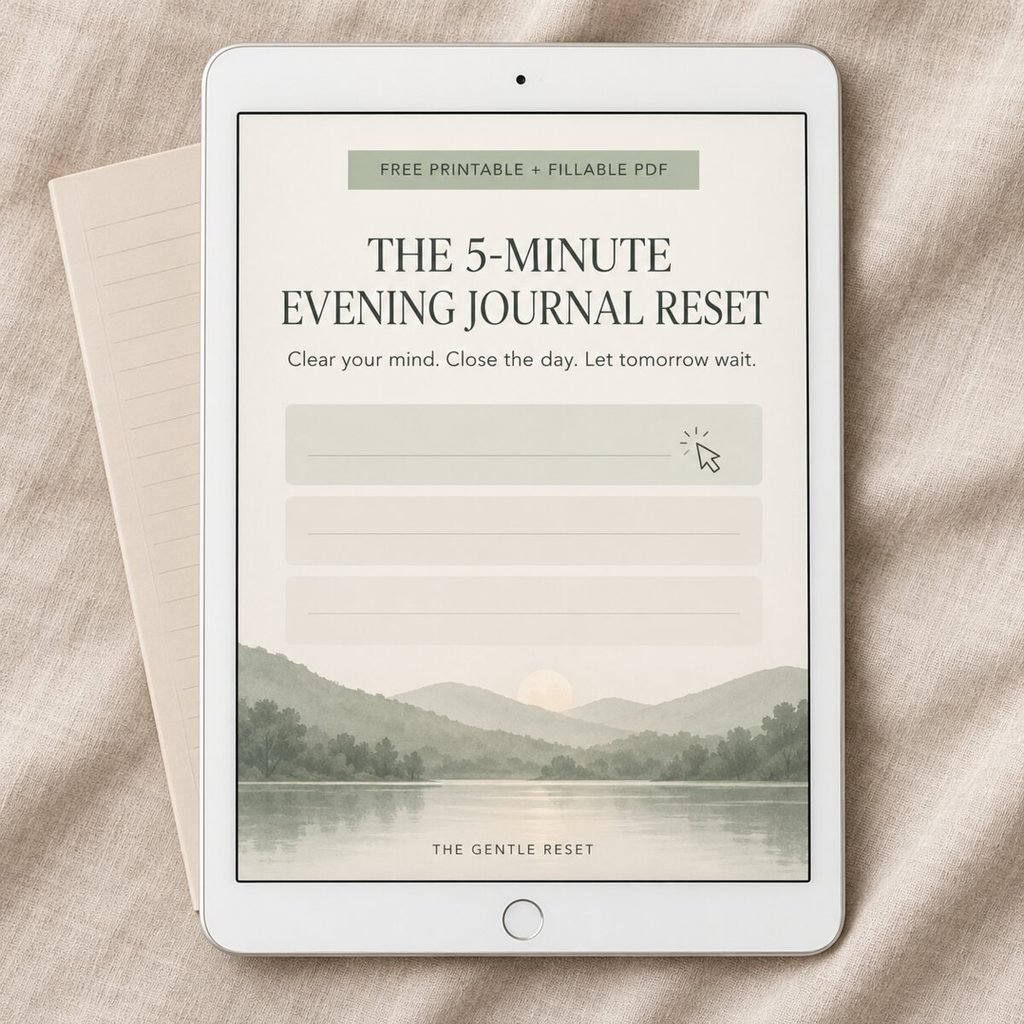
Already have it? Open your copy and try the first question tonight. You don’t need to complete every section.
When you want to bring the rest of your evening together
Some evenings, writing is enough.
Other evenings, you might want guidance choosing one small home task and deciding where to stop.
The Night Reset System™ connects those pieces: Close the Mental Loop, Reset the Space, and Signal Rest. It’s a printable and fillable guided workbook with a 30-day journal and options for evenings when you have less time or energy.
It’s a one-time $17 purchase, yours to keep and reuse.
Explore the Night Reset System™ →
For tonight, begin with one sentence.
You don’t have to finish everything to give the day a stopping point.
With gentleness,
Peace
The Gentle Reset