15 Back-to-School Organization Ideas for Busy Moms
School has a way of taking over the house before the first week is even finished.
A backpack lands beside the kitchen counter.
New papers are waiting to be signed.
Someone cannot find the shoes they need—even though there are several other pairs by the door.
Lunch containers need to be washed. Water bottles need to be filled. And there always seems to be one more date, form, or school supply to remember.
I remember one morning when we were ready to leave—or at least I thought we were.
Then we needed to find a missing water bottle, a paper that was supposed to be signed, and the other shoe that somehow was not beside the first one.
None of those things was a big problem on its own. But together, they made the entire morning feel harder than it needed to be.
That was when I realized we did not need a perfectly organized command center.
We just needed a few predictable places for the things we use every school day.
These back-to-school organization ideas are designed for real homes and busy moms. They can work whether you have a large entryway, one small closet, or a corner beside the kitchen that everyone walks past.
The goal is not to organize your entire house.
It is to remove a few repeated decisions from school mornings so everyone can move through them a little more easily.
What should you organize before school starts?
Before you begin moving baskets or labeling containers, think about the things that affect your school day most often.
These are usually:
What your children carry to school
What comes home from school
What everyone needs before leaving in the morning
What can be prepared the night before
What you need to check during the week
You do not need to organize every closet and drawer before school starts.
The goal is much simpler: give the things your family uses every school day an easy-to-find home.
The best system is not necessarily the prettiest one. It is the one your family can use without you constantly reminding everyone where things belong.
If you only organize three things before school starts
If you do not have the time or energy to work through all 15 ideas, begin with these three:
Create one drop zone for backpacks and school shoes.
Make one place for papers that need your attention.
Prepare clothes, backpacks, and special items the night before.
Those three small systems address some of the most common reasons school mornings become stressful.
You can always add the other ideas later.
Back-to-school entryway organization ideas
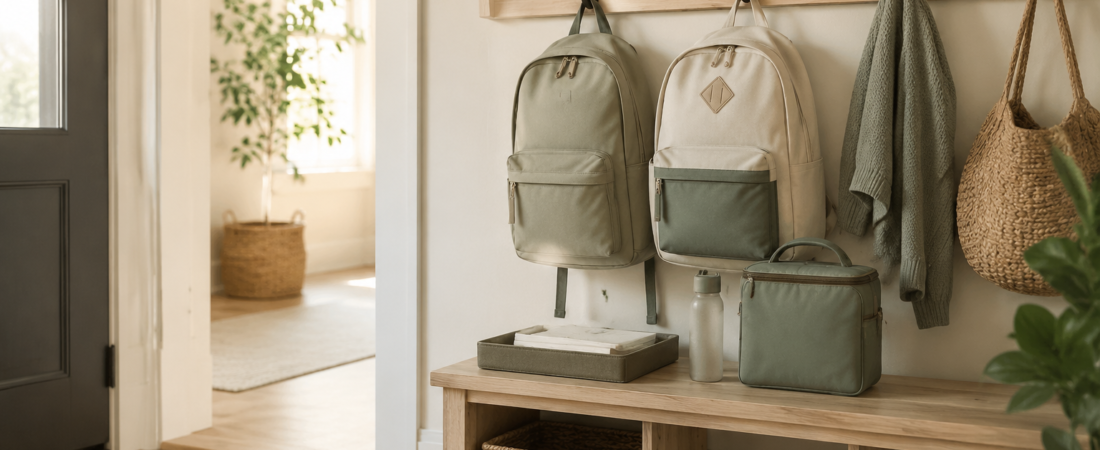
1. Choose one backpack drop zone
Backpacks usually land wherever children stop first.
Sometimes that is beside the front door. Sometimes it is the kitchen floor. Sometimes it is directly in the middle of the walkway you need to use.
Instead of fighting that natural habit, notice where the backpacks already tend to land. Then create their official home nearby.
You could use:
Wall hooks
A small bench
A basket beside the door
The side of a bookcase
One section of a coat closet
If you have limited space, wall hooks can work especially well because they use vertical space instead of taking up more floor space.
Backpack organization at home does not require a separate mudroom. It only requires one place that is easy for everyone to remember.
Small action for today: Choose the place where backpacks will live and clear just enough room for them.
2. Give lunch bags and water bottles a home
Lunch bags have a habit of staying inside backpacks long after the school day is over.
Create one simple routine for unpacking them.
When your child comes home, the lunch bag can go beside the sink or in one designated kitchen spot. Water bottles can go directly into the sink or dishwasher.
You can also choose one drawer, shelf, or basket for clean lunch supplies. Keeping containers, lids, and water bottles together makes it easier to see what is available when you are preparing for the next day.
This does not need to become an elaborate lunch-packing station.
One shelf is enough.
If your lunch and breakfast supplies are spread throughout the pantry, a simple five-minute pantry reset can help you create one easy-to-reach area for the things you use most often.
Small action for today: Choose one place where lunch bags will go as soon as everyone comes home.
3. Create a small school-shoe station
School mornings can come to a complete stop over one missing shoe.
Try keeping the pairs worn most often for school close to the door your family uses in the morning.
Depending on your space, this could be:
A shallow basket
A small shoe rack
A washable mat
One assigned space for each child
You do not need to store every pair of shoes here. Keep only the pairs that are actually part of the regular school routine.
The fewer choices and piles everyone has to search through, the easier it is to get out of the house.
Small action for today: Place one school pair per child beside the door tonight.
4. Keep last-minute essentials near the door
Think about the small items your family frequently remembers at the last minute.
Maybe it is sunscreen.
Maybe it is a hair tie, an umbrella, a library book, or an extra pair of socks.
A small basket near the door can hold a few of these easy-to-forget essentials.
The key is to keep the basket small and intentional. If everything gets tossed into it, it will quickly become another place you have to search.
Include only the things your family regularly needs before leaving.
How to organize school papers at home
5. Make one place for papers that need attention
School papers can take over the kitchen counter faster than almost anything else.
There are permission slips, activity notices, forms to sign, homework pages, artwork, and information you may need later.
Instead of letting every paper join one growing pile, create a single place for anything that requires your attention.
You might use:
A folder
A wall pocket
A shallow tray
A magazine holder
You can label it something simple like:
Check This Week
Place permission slips, forms, event notices, and anything requiring a signature there.
Now, when you have a few quiet minutes, you know exactly where to look.
Small action for today: Place one folder or tray on the counter and label it “Check This Week.”
6. Separate papers to keep from papers to recycle
Not every paper needs to become a memory.
When school papers come home, try making one of three decisions:
Act on it.
Keep it.
Recycle it.
Important records, meaningful artwork, report cards, and a few special pieces of schoolwork can go into a designated folder or keepsake box.
Everything else can leave the house after it has served its purpose.
This keeps you from creating a complicated filing system for papers you may never need again.
7. Create a temporary home for completed homework
Completed homework needs a place to wait until it returns to the backpack.
Without one, finished pages can easily disappear beneath mail, notebooks, or papers on the kitchen counter.
The temporary home could be:
A folder inside the backpack
A tray beside the backpack station
A labeled vertical file
One section of your child’s desk
Keep this location close to where backpacks are packed. The easier the path from “finished” to “ready for school,” the less likely the homework is to be forgotten.
Small action for today: Decide where completed homework will wait and show your child the new spot.
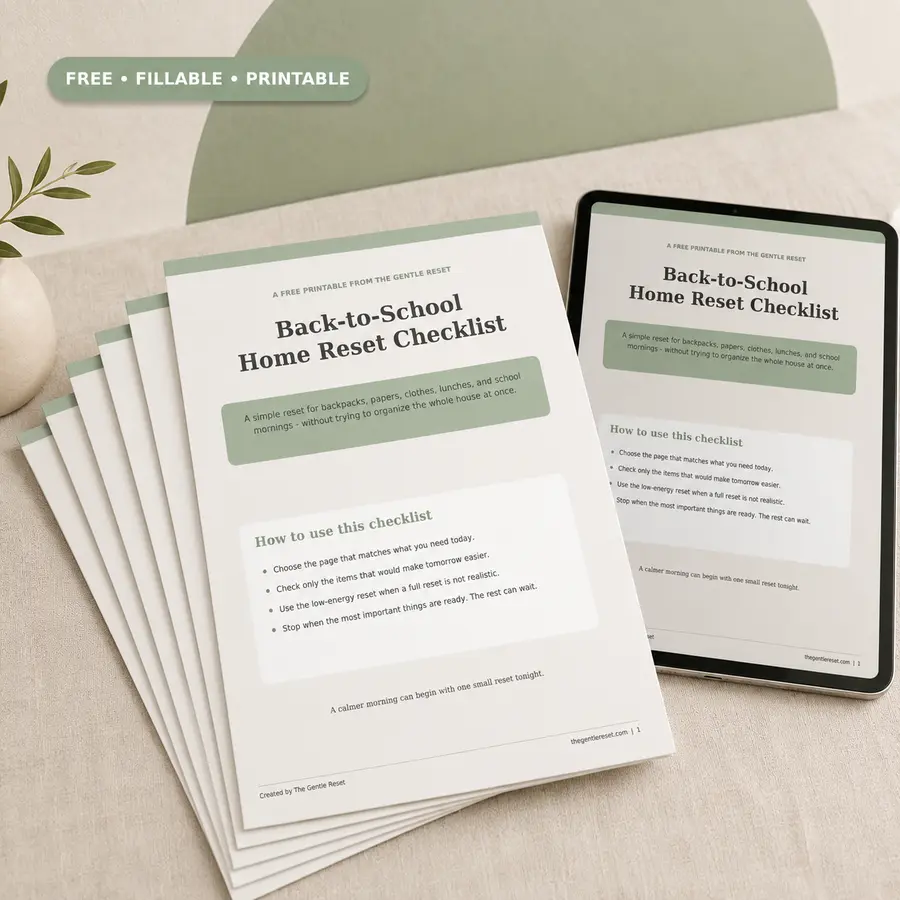
Make your back-to-school reset easier
The free Back-to-School Home Reset Checklist gives you a simple room-by-room plan for preparing the areas school mornings depend on most.
It includes:
Backpack, shoe, and school-paper setup
Clothing, lunch-supply, and morning-essential resets
A simple night-before and weekly school checklist
You can work through it one small area at a time—without reorganizing your entire house.
Choosing clothes does not sound like a big task—until you are already running late and the shirt someone wants is still in the laundry.
Preparing one complete outfit the night before removes one decision from the morning.
You could hang the outfit on a hook, place it in a small basket, or leave it neatly on a chair.
Some families enjoy choosing several outfits at the beginning of the week. If that helps you, use it. But you do not need a full weekly clothing organizer to make this idea work.
Preparing tomorrow’s clothes is enough.
Small action for tonight: Set out one complete outfit, including socks and anything else your child will need.
9. Keep socks and hair accessories together
Sometimes the smallest missing item causes the longest delay.
If socks regularly disappear, consider keeping a small basket of school socks close to where your children get dressed.
Hair accessories can also have one simple container with the brush, hair ties, clips, or other items used most often.
The location does not have to follow traditional organizing rules. It needs to be convenient for your family’s real morning routine.
10. Create a morning-ready basket
A small morning-ready basket can hold the personal items your child uses after getting dressed.
Depending on your child’s age, it might include:
A brush or comb
Lotion
Hair accessories
Deodorant
Other ordinary personal-care essentials
Keep only the items needed for a typical school morning.
The basket can stay in the bedroom, bathroom, or wherever your child usually gets ready. This keeps everyone from moving from room to room looking for small things.
11. Post one visible morning checklist
A short morning checklist can reduce how many reminders you have to give.
Keep it simple:
Get dressed.
Eat breakfast.
Brush your teeth.
Pack your lunch.
Take your backpack and water bottle.
Place the checklist where the routine actually happens.
For younger children, you can use pictures instead of written instructions. For older children, a small list near the door or bathroom mirror may be enough.
The checklist is not meant to control every minute of the morning. It is simply a gentle reminder of what needs to happen before everyone leaves.
Small action for today: Write the five most important morning tasks on a piece of paper and place it where your child will see it.
Back-to-school night-before organization routine
12. Reset backpacks before bed
A short backpack reset can prevent several morning surprises.
Before bed:
Remove school papers and food containers.
Check that homework is complete.
Return signed forms.
Add anything needed for the next day.
Put the backpack back in its assigned place.
This night-before backpack routine does not need to take long.
Once the papers and lunch items are removed, most backpacks can be reset in just a few minutes.
13. Check tomorrow’s schedule once
School schedules often include small changes that are easy to forget.
There may be library day, gym clothes, a special activity, an appointment, a form that is due, or something different needed for lunch.
Choose one time in the evening to check tomorrow’s schedule.
Look for:
School events
Activities or practices
Library days
Special clothing
Forms or payments
Weather-related needs
After checking, prepare what you can and let the rest wait until tomorrow.
You do not need to keep mentally reviewing the schedule throughout the entire evening.
If you have difficulty feeling finished once the practical tasks are done, these tiny evening resets offer a few gentle ways to bring the day to a close.
14. Do a 10-minute school-night kitchen reset
The kitchen often becomes the center of the school-night pileup.
Lunch containers arrive there. Backpacks pass through. Papers land on the counter. Breakfast and lunch preparation start all over again.
A short kitchen reset can help restore the areas tomorrow morning depends on most.
You might:
Empty lunch containers.
Clear the sink or one section of the counter.
Prepare water bottles.
Set out breakfast essentials.
Make space for the next morning.
This is not deep cleaning. It is simply a way to make the kitchen usable again.
If your kitchen tends to hold the unfinished pieces of the school day, try my 10-minute school-night kitchen reset. It walks you through a simple closing routine without turning it into a full cleaning session.
Small action for tonight: Set a timer for 10 minutes and reset only the areas tomorrow morning will need.
Keep the system manageable throughout the school year
15. Do one gentle weekly school reset
Even the best organization system needs a little attention after a busy week.
Choose one day for a short weekly school reset. This could be Friday afternoon, Sunday evening, or whenever your family naturally begins preparing for the next week.
During the reset, you might:
Empty backpacks completely.
Recycle outdated papers.
Return supplies to their places.
Wash lunch bags and water bottles.
Check the upcoming calendar.
Restock anything that is running low.
Choose the first school outfit of the week.
Some weeks, removing old papers and checking the calendar may be enough.
The purpose is to prevent several small school-related tasks from becoming one overwhelming project later.
Small action for today: Choose the day when your weekly school reset will happen.
A realistic back-to-school setup plan
You do not have to set up every system at once. Use this simple sequence to begin with what will make the biggest difference.
Time available
Small reset
5 minutes
Create a folder for papers that need attention
10 minutes
Set up a backpack and school-shoe drop zone
Each evening
Prepare clothes, reset backpacks, and check tomorrow’s schedule
Once a week
Remove old papers, clean lunch supplies, and check the calendar
Start with the smallest option that solves a problem you are dealing with right now.
Back-to-school organization for small homes
You do not need a large mudroom, separate homework room, or built-in command center to organize your home for the school year.
In a small home, the most useful systems are often the simplest.
Try using:
Hooks instead of floor-standing storage
The inside of a closet or cabinet door
One portable basket for frequently used supplies
A narrow wall pocket for school papers
One shelf for lunch containers and water bottles
A small section of an existing closet
Keep daily items near where your family uses them. Store seasonal or rarely used school supplies somewhere less accessible.
Before buying a new organizer, try the routine with a basket, folder, tray, or container you already own.
You may discover that you do not need more storage. You simply need fewer items in the area and a clearer place for each one.
Back-to-school organization at home is less about having extra space and more about making everyday items easy to find and easy to return.
How to start without reorganizing everything
Looking at 15 ideas at once can make this feel like another project.
It does not have to become one.
Start with what causes the most frustration
Ask yourself what regularly slows your family down.
Are backpacks constantly missing?
Are school papers taking over the kitchen counter?
Are clothing decisions making mornings harder?
Do lunch containers and water bottles seem to disappear?
Choose the one problem that happens most often. Start there.
Test one simple solution
Look for a basket, hook, tray, folder, magazine holder, or small container that could support the new routine.
Then give the system one school week before deciding whether it works.
Notice:
Can everyone find the item?
Can your children return it without help?
Is the location convenient?
Is the system creating more work for you?
If something is consistently left somewhere else, the problem may be the location—not your family.
Move it closer to where the item is naturally used or dropped.
A helpful system should make everyday life easier. If it does not, you are allowed to simplify it.
A gentle reminder before the school year begins
The goal of back-to-school organization is not to create a house where nothing is ever misplaced.
Backpacks may still land on the floor.
A water bottle may still be forgotten.
There will probably be a morning when the shoes someone needs are nowhere near the shoe basket.
That does not mean your system has failed.
These small routines are simply here to reduce a few repeated decisions and give the things your family uses most often predictable homes.
You are not trying to organize every part of family life.
You are making ordinary school days a little easier to move through.
When the practical reset is finished but your day still feels open
School systems can help you prepare the backpacks, papers, clothes, and kitchen. But sometimes, even after those things are handled, you are still mentally carrying the unfinished pieces of the day.
The Night Reset System is a gentle 5–10 minute evening practice designed to help you close the mental loop, reset your space, and create a sense of closure at the end of the day.
It is not another family command center or complicated planning system. It is a simple reset created for you.
If Sunday is when your family prepares for the school week, try this realistic Sunday reset routine for busy moms. It includes a 15-minute option and a low-energy version for weeks when you cannot manage the full list.
Frequently asked questions
How do I organize my home for back to school?
Start with the items your family uses every school day: backpacks, lunch supplies, school papers, frequently worn clothes, shoes, and morning essentials. Give each category one easy-to-reach home before trying to organize less frequently used items.
How can I organize school supplies in a small space?
Choose one portable container, drawer, cart, or cabinet section for the supplies your children use regularly. Avoid spreading supplies across several rooms. Use vertical space, wall pockets, and the inside of cabinet or closet doors when appropriate.
What should be included in a back-to-school organization checklist?
A useful checklist can include backpacks, lunch containers, water bottles, school papers, clothing, shoes, morning essentials, important dates, and a short night-before routine. Keep it focused on the tasks that affect everyday school mornings.
How can I keep school papers from creating clutter?
Use one location for papers requiring action, one folder or box for papers worth keeping, and recycle outdated papers during a short weekly reset. Avoid combining school papers with household mail whenever possible.
What can I prepare the night before school?
You can prepare clothing, backpacks, signed papers, lunch components, water bottles, and anything special needed the following day. Checking tomorrow’s schedule once can help you decide what actually needs to be prepared.
Start with one easier morning
You do not need to set up all 15 of these back-to-school organization ideas before the first day of school.
Choose one area that repeatedly creates frustration.
Give the backpacks a home.
Make one place for papers that need your attention.
Prepare tomorrow’s clothes.
Clear one section of the kitchen counter.
One small system can remove one repeated decision from your day.
And sometimes, one easier morning is a very good place to begin.
Choose your first school reset today, then use the free checklist to work through the rest whenever you are ready.
To provide the best experiences, we use technologies like cookies to store and/or access device information. Consenting to these technologies will allow us to process data such as browsing behavior or unique IDs on this site. Not consenting or withdrawing consent, may adversely affect certain features and functions.
Functional
Always active
The technical storage or access is strictly necessary for the legitimate purpose of enabling the use of a specific service explicitly requested by the subscriber or user, or for the sole purpose of carrying out the transmission of a communication over an electronic communications network.
Preferences
The technical storage or access is necessary for the legitimate purpose of storing preferences that are not requested by the subscriber or user.
Statistics
The technical storage or access that is used exclusively for statistical purposes.The technical storage or access that is used exclusively for anonymous statistical purposes. Without a subpoena, voluntary compliance on the part of your Internet Service Provider, or additional records from a third party, information stored or retrieved for this purpose alone cannot usually be used to identify you.
Marketing
The technical storage or access is required to create user profiles to send advertising, or to track the user on a website or across several websites for similar marketing purposes.